COCREON INSIGHTS | Music Industry / Independent Artists | November 2026
The Freedom to Create — and the Cost of Independence
Imagine being able to write a song in your bedroom, record it on a laptop, distribute it worldwide and reach listeners on several continents without signing a traditional record deal.
A generation ago, that level of independence would have been difficult to imagine for many musicians. Today, it is an ordinary part of the digital music landscape.
Affordable recording equipment, digital audio workstations, global distribution services, social media and increasingly sophisticated artificial intelligence tools have transformed what independent artists can accomplish.
A musician no longer needs a major-label contract to release a professionally produced recording. A small team — or even one individual — can manage songwriting, production, artwork, distribution and international promotion.
The barriers to creating and releasing music have fallen dramatically. But another barrier remains.
Creating music has become more accessible. Making a living from it has not necessarily become easier.
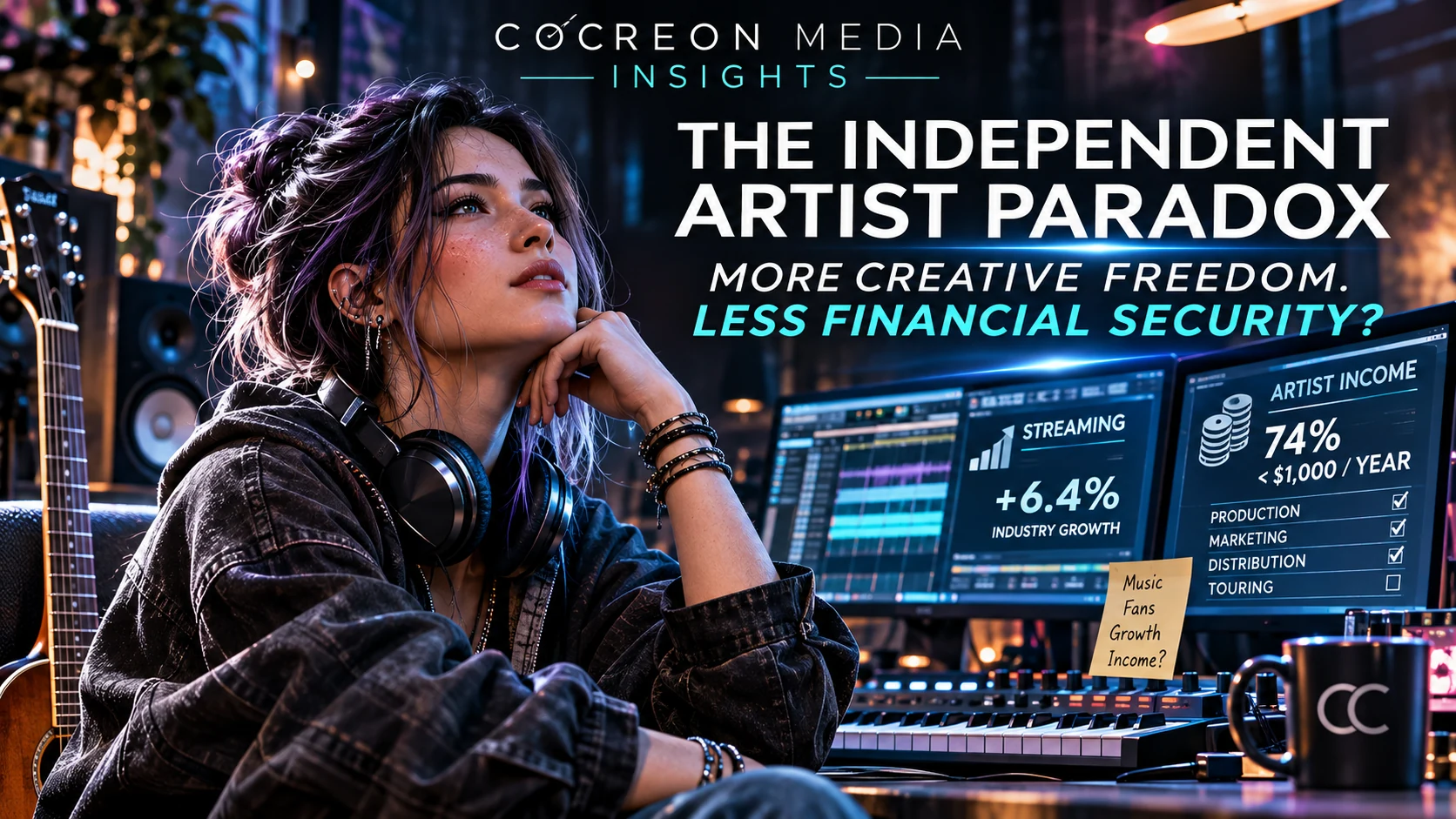
This is the independent artist paradox.
Musicians have gained unprecedented control over their creative work while often assuming greater responsibility for the financial risks, marketing demands and operational complexity surrounding it.
New research published in 2026 provides a revealing picture of that contradiction.
A Growing Music Industry — But Who Benefits?
At first glance, the global recorded music business appears remarkably healthy.
According to IFPI's Global Music Report 2026, worldwide recorded music revenues reached $31.7 billion in 2025, representing annual growth of 6.4%. It was the industry's eleventh consecutive year of revenue growth.
Streaming remained the principal engine of expansion, generating more than $22 billion and accounting for 69.6% of recorded music revenues worldwide. Paid subscription streaming alone grew by 8.8%.
These figures demonstrate that consumers continue to spend substantial amounts of money on recorded music. They also challenge the idea that the music business as a whole is in decline.
Yet market growth and individual financial security are not the same thing.
Industry revenue measures money flowing through the recorded music ecosystem. It does not reveal how that income is distributed among artists, songwriters, performers, producers, labels, publishers and other rights holders.
Nor does it measure the financial circumstances of every musician who releases music independently.
A growing industry can create more successful careers while still leaving a large number of participants struggling to earn meaningful income. Understanding both realities is essential.
The $1,000 Reality: What Independent Artists Reported in 2026
In September 2026, independent music distributor Ditto Music published its Independent Music Report 2026, based on responses from 5,039 independent artists across 112 countries.
The findings were striking.
74% of respondents reported earning less than $1,000 from music during the previous year.
Only 9% reported earning $5,000 or more, while just 4% reached at least $15,000.
For most of the surveyed musicians, music was not generating anything close to a full-time income.
The report also found that:
- 64% worked a full-time or part-time job outside music.
- Another 14% relied on family support or savings.
- Only 22% described music as their full-time occupation.
- Just 29% believed their current music income would remain sustainable over the next three years.
The figures suggest a substantial gap between the ability to participate in the music economy and the ability to build a financially secure career within it.
However, these findings require careful interpretation.
Ditto surveyed independent musicians who chose to participate in its research. The sample was international but not necessarily representative of every independent artist worldwide.
The results therefore describe the experiences of respondents rather than establishing a universal income distribution for all musicians.
The survey also covers artists at different career stages, with different goals and varying levels of professional activity.
Someone releasing music as a creative hobby has different financial expectations from an artist attempting to support a family through music.
Even with these limitations, the findings reveal a serious concern. For a substantial proportion of participating musicians, independence has not yet translated into economic sustainability.
The Streaming Contradiction
Streaming is simultaneously one of the greatest opportunities and one of the most contested elements of modern music economics.
It gives independent artists access to global audiences without the physical distribution infrastructure once required to sell recordings internationally.
It also allows music to remain available indefinitely, creating the possibility of long-term catalog income.
Spotify's Loud & Clear reporting offers an important counterpoint to the pessimistic interpretation of independent music earnings.
According to Spotify, the company paid more than $11 billion to the music industry in 2025, with approximately half of those royalties generated by independent artists and labels.
More than 13,800 artists generated at least $100,000 in annual Spotify royalties.
The platform also reported that over one-third of artists generating at least $10,000 in royalties during 2025 were independent DIY artists or had begun their careers through self-releasing.
These numbers demonstrate that independent artists can achieve meaningful commercial success through streaming.
But they do not contradict the difficulties reported in the Ditto survey. The two sources measure different things.
Spotify reports royalties generated by recordings and associated rights holders within its platform. Those amounts are not necessarily the personal take-home income of individual artists.
Royalties may be divided among labels, distributors, collaborators, publishers and other parties according to contractual arrangements.
Artists must also account for production, marketing, management and other business expenses.
Ditto, by contrast, asked individual musicians about their reported music earnings and career circumstances.
A platform can generate billions in royalties while many individual artists earn very little. Both statements can be true.
The economic challenge is therefore not simply whether streaming creates revenue. It is how effectively that revenue reaches individual creators — and whether it can support the costs of developing a career.
The New Bottleneck: Being Heard
For much of the twentieth century, access to professional recording and distribution was a major obstacle for independent musicians. Today, those barriers have been reduced.
But the ability to distribute a recording does not guarantee that anyone will discover it.
Digital platforms offer listeners an extraordinary volume of music, competing not only with new releases but also with decades of recorded catalogs.
Independent artists therefore face a different challenge: attracting and maintaining attention.
The Ditto survey illustrates the importance of this shift.
Among respondents, 67% identified social video platforms as their biggest source of new fans. TikTok and YouTube together accounted for 49%.
Only 1% identified editorial playlists alone as their primary source of new listeners, while 17% selected Spotify's algorithmic or editorial playlists as a combined category.
These figures reflect artists' reported experiences, not independently measured attribution across every platform.
Nevertheless, they suggest that music discovery increasingly extends beyond traditional release channels.
A song may first reach a listener through a short video, a creator's recommendation, a social conversation or a piece of visual storytelling.
Streaming platforms remain central to listening and monetization, but discovery often begins elsewhere.
For independent musicians, this creates a new operational reality. Releasing the music is only the beginning. The artist must also find ways to introduce it to an audience.
When Musicians Become Content Creators
The growing importance of social platforms has changed what it means to manage an independent music career.
According to Ditto, 86% of surveyed artists create social content to promote their music. Three out of four believe social media success is essential to a music career.
Yet the skills required to produce engaging short-form videos, manage communities, analyze advertising campaigns and maintain a consistent online identity are not necessarily the same skills required to write compelling songs.
An independent musician may now be expected to function simultaneously as:
- Songwriter and performer
- Recording producer
- Visual content creator
- Social media manager
- Marketing strategist
- Data analyst
- Business administrator
Each responsibility consumes time and attention. And every hour spent managing promotion is an hour that cannot simultaneously be devoted to composing, rehearsing or recording.
This does not mean social media is inherently harmful to artistic development. For many musicians, it provides opportunities to communicate directly with listeners and build communities without traditional intermediaries.
But it introduces a difficult question.
How much of an independent artist's working life should be devoted to making music — and how much to persuading people to notice it?
There is no universal answer. Different genres, audiences and career models require different approaches.
What matters is recognizing that creative independence often comes with an expanding business workload.
AI Changes the Cost of Creation — Not the Economics of Attention
Artificial intelligence adds another dimension to the independent artist paradox.
Generative music systems, AI-assisted mixing and mastering, automated transcription, stem separation, visual creation and marketing tools can reduce the time or resources required for certain production tasks.
These technologies can be especially useful for artists operating with limited budgets.
The Ditto report found that 47% of respondents already used AI within their music-making processes.
Importantly, the research suggests that AI adoption is not limited to younger musicians.
Among surveyed artists aged 18–24, 24% reported using AI in music-making. Among those aged over 55, the figure was 74%.
This is a particularly interesting finding, although it should not be interpreted as proof that older musicians everywhere are more likely to adopt AI. Differences in the surveyed groups, their experience and their reasons for participating may influence the result.
The report also found that production assistance — including mixing, mastering and vocal processing — was more common among AI users than generating complete songs.
This challenges the simplistic assumption that AI adoption in music primarily means replacing human creativity with automated tracks.
For many creators, AI functions as another production tool.
COCREON INSIGHTS explored this distinction in Beyond the Prompt: Why Human Creative Direction Is Becoming the Most Valuable Skill in AI Music.
But from an economic perspective, an important distinction remains.
AI may reduce the cost of producing music. It does not automatically increase the number of listeners willing to engage with that music.
Nor does it guarantee higher royalties, stronger fan relationships or sustainable revenue.
In fact, if technology makes it easier for more people to release recordings, the competition for attention may become even more intense.
That is not necessarily an argument against AI. It is an argument against confusing production efficiency with commercial success.
The Abundance Problem: When More Music Competes for the Same Attention
The rapid growth of AI-generated content illustrates how dramatically music supply can expand.
In July 2026, Deezer reported receiving approximately 90,000 fully AI-generated tracks per day, with such recordings accounting for more than half of daily deliveries at peak levels in June.
Yet Deezer also reported that fully AI-generated music represented only around 1–3% of listening activity on its platform.
The company excludes detected fully AI-generated recordings from algorithmic recommendations and editorial playlists, a policy that directly affects their discovery.
These figures should not be interpreted as proof that audiences universally reject AI music.
They describe one platform, its detection methods, recommendation policies and reported listening patterns.
They also concern fully AI-generated recordings, not every form of AI-assisted music.
Nevertheless, they demonstrate a broader economic problem.
Increasing the supply of music does not necessarily create a corresponding increase in audience attention.
The number of tracks available can grow much faster than the time listeners have to discover them.
For independent artists, the implication is significant.
Producing more recordings may expand a catalog, but quantity alone does not establish a meaningful audience.
In an environment of abundant content, identity, relevance and sustained listener engagement may become increasingly important.
Why More Streams Do Not Always Mean a Sustainable Business
Streaming figures can be useful indicators of audience reach. But they are not the same as profitability.
Consider two hypothetical independent artists.
Artist A generates substantial streaming activity through paid advertising and promotional campaigns.
Artist B generates fewer streams but maintains a highly engaged audience that purchases merchandise, attends performances or supports the artist through direct sales.
Artist A may appear more successful when measured exclusively by monthly listeners. Artist B may have a more financially sustainable business.
Of course, either artist could also be operating at a loss.
The point is not that one revenue model is inherently superior. It is that streaming volume alone cannot reveal the economic health of an artist project.
A more complete assessment considers revenue, costs, rights ownership, audience retention and the resources required to maintain growth.
This is particularly important when paid promotion is involved.
Advertising can be an effective way to reach potential listeners. But promotional spending should be evaluated against realistic objectives, not simply the largest possible number of streams.
A campaign that introduces music to listeners who return voluntarily may provide more lasting value than one that generates temporary attention without sustained engagement.
Beyond Streaming: The Challenge of Diversifying Income
A financially resilient music career rarely depends on a single revenue source.
Depending on the artist's circumstances, potential income streams may include recorded music royalties, publishing, live performances, merchandise, licensing, direct fan support and commissioned creative work.
Each option has limitations.
Live performance can be rewarding, but touring is expensive.
In the Ditto survey, 82% of respondents said they could not currently afford the expenses associated with touring.
Only 51% had performed live during the preceding twelve months. Among those who had performed, 61% played five shows or fewer.
These figures challenge the assumption that musicians struggling with streaming income can simply compensate by touring more frequently.
Live performance requires transportation, equipment, rehearsal, accommodation, staffing and access to suitable venues. For some artists, those expenses exceed the revenue available from small shows.
Merchandise and direct fan support can create additional opportunities, but they also require an audience willing to purchase.
Sync licensing can generate meaningful revenue when music is selected for film, television, advertising or games, but placements are competitive and unpredictable.
Publishing and neighboring rights may provide valuable additional income, provided the relevant works, recordings and contributions qualify and are properly administered.
The practical lesson is not that every independent artist must pursue every possible income stream.
It is that a sustainable business model should reflect the artist's audience, capabilities, rights position and financial circumstances.
The Hidden Cost of Independence: Time, Pressure and Burnout
The independent music economy is not only a financial story. It is also a story about time and personal sustainability.
Ditto reported that 32% of surveyed musicians had considered quitting music during the previous twelve months.
Financial pressure, marketing responsibilities and the challenge of balancing music with outside employment were among the leading reported sources of stress.
The survey also found that 61% said their music career had negatively affected their mental health to some degree, although the frequency and severity of those experiences varied considerably.
These responses should not be interpreted as clinical diagnoses or proof that independent music careers cause particular mental health conditions.
They do, however, highlight the pressure experienced by many respondents.
The independent artist is often celebrated as an entrepreneur who controls every aspect of a career. But total responsibility can become overwhelming.
When an individual must simultaneously create music, fund releases, manage promotion, monitor performance and maintain financial stability, the freedom to make independent decisions may coexist with considerable personal strain.
A sustainable career therefore requires more than revenue growth. It also requires realistic expectations, manageable workloads and room for creative development.
What a Sustainable Independent Music Strategy Might Look Like
There is no guaranteed formula for success.
Still, the economic realities described in current industry research suggest several principles that independent artists can use when evaluating their own strategies.
1. Define Success Before Measuring It
Not every musician needs or wants a full-time commercial career.
For some, success means reaching a small international audience while maintaining another profession. For others, it means earning enough to fund future releases or eventually replace outside employment.
These are different objectives and should be measured differently.
2. Measure Financial Results, Not Only Visibility
Streams, followers and social engagement are useful indicators, but they do not provide a complete business picture.
Track income, promotional expenditure, production costs and recurring expenses.
A growing audience is encouraging. A financially sustainable audience is even more valuable.
3. Build Relationships Rather Than Chasing Isolated Moments
Viral attention can create opportunities, but it is difficult to predict and even harder to sustain.
Artists may benefit from developing recognizable identities, consistent communication and meaningful connections with listeners.
A smaller audience that returns repeatedly can provide a more stable foundation than a much larger audience that engages only once.
4. Use AI to Remove Friction, Not Artistic Identity
AI tools can help reduce repetitive work, test creative possibilities and make professional production techniques more accessible.
But efficiency should support artistic objectives rather than replace them.
The strongest reason for listeners to return is not that a recording was produced quickly. It is that the music offers something they value.
5. Understand and Administer Rights
Artists should understand who owns their recordings, compositions and other creative assets.
Where applicable, accurate metadata, contracts and registrations can help ensure that revenue is collected and allocated correctly.
Rights ownership alone does not guarantee income, but unclear ownership can create avoidable financial problems.
6. Choose Partnerships Strategically
Independence does not have to mean doing everything alone.
Distributors, labels, publishers, managers, promotion specialists and creative collaborators can provide valuable support.
The relevant question is whether a partnership offers measurable benefits, transparent terms and an appropriate balance between cost, control and opportunity.
7. Protect the Ability to Keep Creating
A career strategy that requires unsustainable financial spending or constant personal exhaustion is unlikely to remain healthy over time.
Artists need space to develop their work without treating every release as an immediate commercial test.
Long-term creative consistency can be more valuable than short bursts of activity followed by burnout.
The Changing Role of Independent Labels and Creative Partners
The independent artist paradox also raises questions about the future of music companies.
If artists can record and distribute music without traditional intermediaries, what value should a label provide?
The answer may increasingly involve expertise, coordination and sustainable development rather than access to distribution alone.
Independent labels and creative partners can potentially support artists through release planning, rights administration, marketing, visual development, audience strategy and business infrastructure.
But such relationships must offer genuine value.
An artist should not need to surrender unnecessary control simply to access services that are already widely available.
At the same time, complete independence may not be the most efficient option for every musician.
The emerging opportunity is for flexible partnerships that respect artistic autonomy while providing professional support where it is most useful.
For COCREON Media, whose creative philosophy emphasizes human direction and technological collaboration, this is an important part of the broader industry discussion.
Technology can expand what independent creators are able to accomplish.
But technology alone does not replace experience, judgment, professional relationships or a sustainable business strategy.
The Next Phase of Independence
The independent music revolution has already achieved something remarkable.
Artists can create, release and communicate with audiences on a scale that previous generations could rarely access without substantial industry support.
Streaming has created new commercial opportunities. Digital production has reduced technical barriers. Social platforms have enabled direct discovery. Artificial intelligence is expanding the range of tools available to creators.
None of these developments should be dismissed. But access and sustainability remain different achievements.
The next phase of independent music may be less about giving artists the ability to release more content and more about helping them build careers that can endure.
That will require improvements across several areas: fair and transparent commercial practices, meaningful discovery opportunities, effective rights management, responsible technology adoption and realistic business education.
It will also require artists to make difficult decisions about where to invest their time, money and creative energy.
The goal should not be to transform every musician into a full-time entrepreneur.
Nor should financial performance become the only measure of artistic value.
Music can be culturally meaningful even when it produces little commercial income.
But musicians who want to build sustainable professional careers deserve an economic environment in which that ambition is realistically possible.
Creative Freedom Is Only Half the Story
The greatest achievement of the digital music era may be that more people than ever can participate in music creation.
Its unresolved challenge is ensuring that participation can lead to meaningful opportunities rather than simply increasing competition for limited attention.
The independent artist paradox is not evidence that technological progress has failed.
It is evidence that creative access and economic security do not automatically develop at the same pace.
AI may make production faster. Distribution may make releases easier. Social platforms may make global audiences more accessible.
But none of these advantages removes the need for artistic identity, audience relationships, financial discipline and a sustainable long-term strategy.
The future of independent music should not be measured only by how many artists can release a song.
It should also be measured by how many can continue creating on their own terms.
Editorial Disclosure
This article combines published industry research, platform-reported economic data and independent editorial analysis.
COCREON Media operates within the independent music and creative industries, including activities involving AI-assisted music production. The company therefore has a professional interest in the subjects discussed.
The Ditto Music Independent Music Report 2026 is based on survey responses and should not be interpreted as a statistically representative census of all independent musicians worldwide.
Spotify and Deezer figures reflect their respective reporting methods, definitions and commercial environments. Industry-wide revenues, platform royalties and individual artist earnings are not directly interchangeable.
This article is intended for general information and editorial discussion, not financial, legal or investment advice.
Sources and Further Reading
- Ditto Music (September 29, 2026) — The Independent Music Report 2026. Survey of 5,039 independent artists across 112 countries. https://dittomusic.com/en/independent-music-report-2026
- Ditto Music (September 29, 2026) — New Ditto Music Survey Reveals 74% of Independent Artists Earned Under $1,000 in 2025, Even as Releasing Music Gets Easier. https://press.dittomusic.com/new-ditto-music-survey-reveals-74-of-independent-artists-earned-under-1000-in-2025-even-as-releasing-music-gets-easier
- IFPI (March 18, 2026) — Global Music Report 2026: Global Recorded Music Revenues Grow 6.4% as Record Companies Drive Innovation. https://www.ifpi.org/global-music-report-2026-global-recorded-music-revenues-grow-6-4-as-record-companies-drive-innovation/
- IFPI (2026) — Global Music Report 2026: State of the Industry. https://www.ifpi.org/wp-content/uploads/2026/03/GMR2026_SOTI.pdf
- Spotify (March 11, 2026) — As Spotify Turns 20, the Most Global and Diverse Music Industry in History Has Taken Shape. https://newsroom.spotify.com/2026-03-11/loud-and-clear-music-economics-highlights/
- Spotify (January 28, 2026) — From $11B in 2025 Payouts to What We're Building for Artists in 2026. https://newsroom.spotify.com/2026-01-28/2025-music-industry-payouts-whats-next-for-artists/
- Deezer (July 21, 2026) — AI Music Has Surpassed 50% of New Music Uploads for the First Time. https://newsroom-deezer.com/2026/07/ai-music-exceeds-50-percent-daily-uploads-deezer/
- IFPI (September 9, 2026) — EU Recorded Music Revenues Reach €6.0 Billion as European Music, Culture and Innovation Continue to Excel. https://www.ifpi.org/eu-recorded-music-revenues-reach-e6-0-billion-as-european-music-culture-and-innovation-continue-to-excel/
- Spotify Loud & Clear (2026) — 2025 Takeaways. https://loudandclear.byspotify.com/takeaways/
- COCREON INSIGHTS — Beyond the Prompt: Why Human Creative Direction Is Becoming the Most Valuable Skill in AI Music. https://cocreon.com/insights/beyond-the-prompt-human-creativity-ai-music/