The Age of Infinite Musical Possibilities
For much of music history, turning an idea into a finished recording required access to instruments, technical knowledge, studio equipment, musicians, or significant financial resources. Digital audio workstations made production more accessible. Virtual instruments expanded the possibilities further. Generative artificial intelligence is now accelerating that transformation at an unprecedented pace.
A musical sketch can become a fully arranged demo in minutes. A producer can experiment with unfamiliar genres, explore vocal arrangements, develop alternative instrumental textures, or test ideas that would previously have required extensive recording sessions.
Yet this new abundance introduces a fundamental question:
When almost anyone can generate convincing musical material, what makes an artist's work distinctive?
The answer may lie less in the technology itself than in the decisions made around it.
A generative model can produce possibilities. It cannot, by itself, establish why a particular musical statement should exist, what an artist intends to communicate, or how an evolving body of work should express a coherent identity.
That distinction is becoming central to the future of AI-assisted music.
From Technical Execution to Creative Direction
Music production has always involved more than performing notes or operating equipment.
A producer decides when a chorus needs greater emotional intensity, whether a vocal should feel intimate or distant, when an arrangement becomes overcrowded, and which imperfections give a recording its character.
These decisions are often subtle. They may involve removing an instrument rather than adding one, changing a single chord, rewriting a lyric, or rejecting a technically impressive take because it does not serve the song.
Generative AI can accelerate parts of this process, but it also increases the importance of selection.
If a musician can generate twenty arrangements in the time previously needed to develop one, the challenge changes. The bottleneck is no longer simply producing alternatives. It becomes recognizing which alternative has artistic value — and understanding why.
This shift can be described as a move from technical execution toward creative direction.
However, the two should not be treated as opposites. Musical skill, instrumental experience, composition, engineering, and performance remain valuable precisely because they help artists evaluate and transform the material AI systems produce.
The future-ready musician is not necessarily the person who generates the most material. It may be the person who knows what to keep, what to change, and what to leave behind.
Why a Prompt Is Only the Beginning
A prompt can describe a genre, mood, tempo, instrumentation, or vocal character. It can also establish a useful creative starting point.
But a prompt is not the same thing as a finished artistic vision.
Consider two producers working with similar AI-generated musical material.
One accepts the first convincing result and releases it with minimal intervention.
The other uses the result as a foundation, restructures the arrangement, replaces selected instrumental parts, records new performances, rewrites sections, adjusts harmonic transitions, develops vocal layers, and integrates the track into a recognizable artistic concept.
Both workflows may involve generative AI, but they represent very different forms of creative engagement.
Neither the number of hours invested nor the amount of manual editing automatically guarantees artistic quality. A simple work can be powerful, while an elaborate production can remain emotionally empty.
The relevant distinction is not effort alone.
It is whether creative choices are being made deliberately, with an understanding of the work's musical and expressive purpose.
This is also why the familiar debate over so-called "AI slop" can become unproductive when it treats every AI-assisted recording as equivalent.
The more useful question is not simply whether AI was involved.
It is how the technology was used, what the human contributors actually created, and whether the resulting work communicates something distinctive.
For a broader discussion of this distinction, see our related COCREON INSIGHTS feature, Co-Creation vs. AI Slop: Why Human Intent Still Matters.
The Producer as Editor, Architect and Storyteller
As generative systems become more capable, three dimensions of creative direction deserve particular attention.
1. Musical Judgment: Knowing What Serves the Song
A convincing recording is not necessarily a compelling song.
Generative systems may produce polished arrangements, familiar hooks, and technically coherent performances. But polish can also conceal predictability.
A producer's judgment becomes essential when deciding whether a melody has genuine character, whether the structure sustains attention, or whether an arrangement supports the emotional narrative.
This requires critical listening, musical experience, and a willingness to discard attractive but unnecessary ideas.
The ability to reject material may become as important as the ability to generate it.
2. Production Architecture: Turning Fragments into a Coherent Work
AI-assisted music production need not be a single-step process.
Generated material can be separated into stems, edited within a digital audio workstation, combined with newly recorded performances, and rebuilt through conventional production techniques.
A producer might retain an atmospheric texture while replacing the drums, bass, and guitars. Another might use a generated vocal idea as a reference before developing a different performance or arrangement.
The final recording can emerge through multiple iterations involving both algorithmic material and human musicianship.
This kind of workflow shifts the emphasis from obtaining a complete output to designing a production in which every element has a purpose.
The central skill is not merely operating an AI system. It is understanding how musical components interact.
3. Artistic Identity: Creating Something That Lasts Beyond One Track
Perhaps the greatest challenge in an era of abundant music generation is continuity.
A successful artist is rarely defined by a single technically competent recording. Artistic identity develops through recurring musical choices, lyrical themes, visual language, emotional perspective, and relationships with listeners.
AI can help explore these elements. But building a recognizable creative universe requires consistency and intention.
Why does an artist return to certain themes? What distinguishes their sound? How do successive releases relate to one another? What should listeners recognize even when the musical style changes?
These questions belong to artistic direction.
And they become especially important for virtual artists, whose identities may extend beyond sound recordings into characters, visual storytelling, and fictional worlds.
What Research and Industry Policy Tell Us
The importance of human creative agency is increasingly reflected in discussions beyond the recording studio.
A September 2026 survey paper, Human-AI Co-Creativity: Advances, Opportunities, and Challenges, emerging from an ICML 2026 workshop, examines the expanding research field of human-AI collaboration and identifies open questions about how creative systems should support people.
The broader implication is that creative AI should not be evaluated solely by the quality of its standalone outputs. The relationship between human intention, interaction, control, and creative results also matters.
Meanwhile, the music industry is developing more explicit distinctions between different uses of generative technology.
In July 2026, a coalition of music organizations including IFPI, RIAA, A2IM, WIN, IMPALA, and others introduced a voluntary labeling approach distinguishing AI-Generated from AI-Assisted sound recordings.
Under the announced framework, "AI-Generated" covers recordings in which generative AI produces the entirety or primary portion of the recording's creative elements. "AI-Assisted" is defined more narrowly, applying to recordings substantially created by humans, with humans performing the lead vocal and primary instruments while AI contributes certain expressive elements.
These definitions matter because the everyday expression "AI-assisted music" is often used much more broadly than the proposed industry label.
A producer may describe a complex hybrid workflow as AI-assisted, but that description does not automatically determine how the recording would be classified under a specific labeling framework.
The distinction is particularly relevant when AI-generated lead vocals or principal instrumental performances are involved.
Later that month, IFPI announced principles for AI-related recordings in official charts. Its framework requires qualifying recordings to use properly authorized AI services, be substantially human-made, and avoid stream or chart manipulation concerns.
These are industry chart-eligibility principles, not universal rules governing every release on every streaming platform.
Together, these developments signal a broader change: the music business is beginning to ask more detailed questions about how recordings are created, rather than treating AI as a simple yes-or-no category.
Human Authorship Is Also a Legal Question
Creative direction has artistic value, but its legal significance requires a separate assessment.
In January 2025, the U.S. Copyright Office published its report on the copyrightability of AI-generated outputs.
The Office concluded that AI-assisted works may qualify for copyright protection where sufficient expressive elements are determined by a human author. Human-authored arrangements or modifications may also be relevant, while prompting alone does not necessarily establish authorship of the resulting expression.
This does not mean that every recording involving human editing is automatically protected, nor does it establish a single global standard.
Copyright law varies across jurisdictions, and questions concerning AI training, licensing, musical compositions, sound recordings, performers' rights, and contractual ownership must be considered separately.
Still, the underlying discussion reinforces an important distinction:
Using a creative tool is not necessarily the same as authoring every expressive element it produces.
For musicians, documenting their own contributions may therefore become increasingly valuable.
Session files, original recordings, songwriting drafts, arrangement revisions, and production notes can help explain how a work developed. They do not, by themselves, guarantee legal protection, but they provide a clearer account of the creative process.
The Risk of Musical Homogenization
There is another challenge that deserves attention.
Generative models are exceptionally good at producing recognizable stylistic patterns. Their outputs can sound familiar, polished, and immediately accessible.
That convenience may encourage artists to rely on the same genre descriptions, arrangement formulas, vocal characteristics, and production conventions.
The result can be an abundance of music that sounds professionally assembled but increasingly interchangeable.
This concern extends beyond individual recordings.
In its 2025 report on AI and culture, UNESCO emphasized the importance of cultural diversity, human creative agency, and avoiding algorithmic homogenization.
For music creators, the practical implication is significant.
AI systems can be useful for discovering unexpected possibilities, but originality may require resisting their most predictable suggestions.
That could mean retaining an unconventional arrangement, introducing a deliberately imperfect performance, experimenting with unusual harmonic choices, or combining influences that do not naturally fit a model's most familiar patterns.
It may also mean switching the AI system off and recording something entirely new.
Creative independence is not measured by how frequently an artist uses technology.
It is measured, in part, by whether the artist remains free to make decisions that technology would not automatically favor.
A Practical Framework for AI-Assisted Music Creators
For independent artists and producers, the following principles offer a practical way to keep creative direction at the center of an AI-assisted workflow.
Start With an Artistic Objective
Before generating material, define what the song is intended to communicate.
That objective might involve a lyrical message, a particular emotional progression, an unusual arrangement, or a broader narrative within an artist project.
The clearer the intention, the easier it becomes to evaluate potential outputs.
Treat Generated Material as Options, Not Obligations
A technically impressive result is not automatically the right result.
Compare alternatives critically. Preserve ideas that support the musical concept and discard those that merely sound polished.
Maintain Control of the Arrangement
Whenever the workflow permits, work with editable musical components.
Rearrange sections, revise transitions, replace instruments, record additional performances, and reconsider the balance between generated and human-created material.
Build a Recognizable Artistic Language
Develop recurring creative principles without turning them into rigid formulas.
An identifiable sound can emerge through instrumentation, production choices, lyrical perspective, dynamics, and visual storytelling.
Document Creative Contributions
Keep reasonable records of composition, performance, editing, and production decisions.
Also review the terms of the AI services being used, the rights attached to source material, and the disclosure requirements of relevant distributors or platforms.
Be Transparent Without Reducing Art to a Label
Audiences deserve accurate information about significant uses of generative technology.
At the same time, a simple AI label cannot explain the full complexity of a production process.
Clear descriptions of the actual workflow can communicate far more than a binary classification.
Virtual Artists and the Possibility of New Creative Worlds
The significance of creative direction becomes especially visible in virtual music projects.
A virtual artist can combine songwriting, sound production, visual design, character development, and long-term storytelling within a single creative identity.
In such projects, the artistic work is not limited to producing individual songs.
It also involves developing a world in which those songs have meaning.
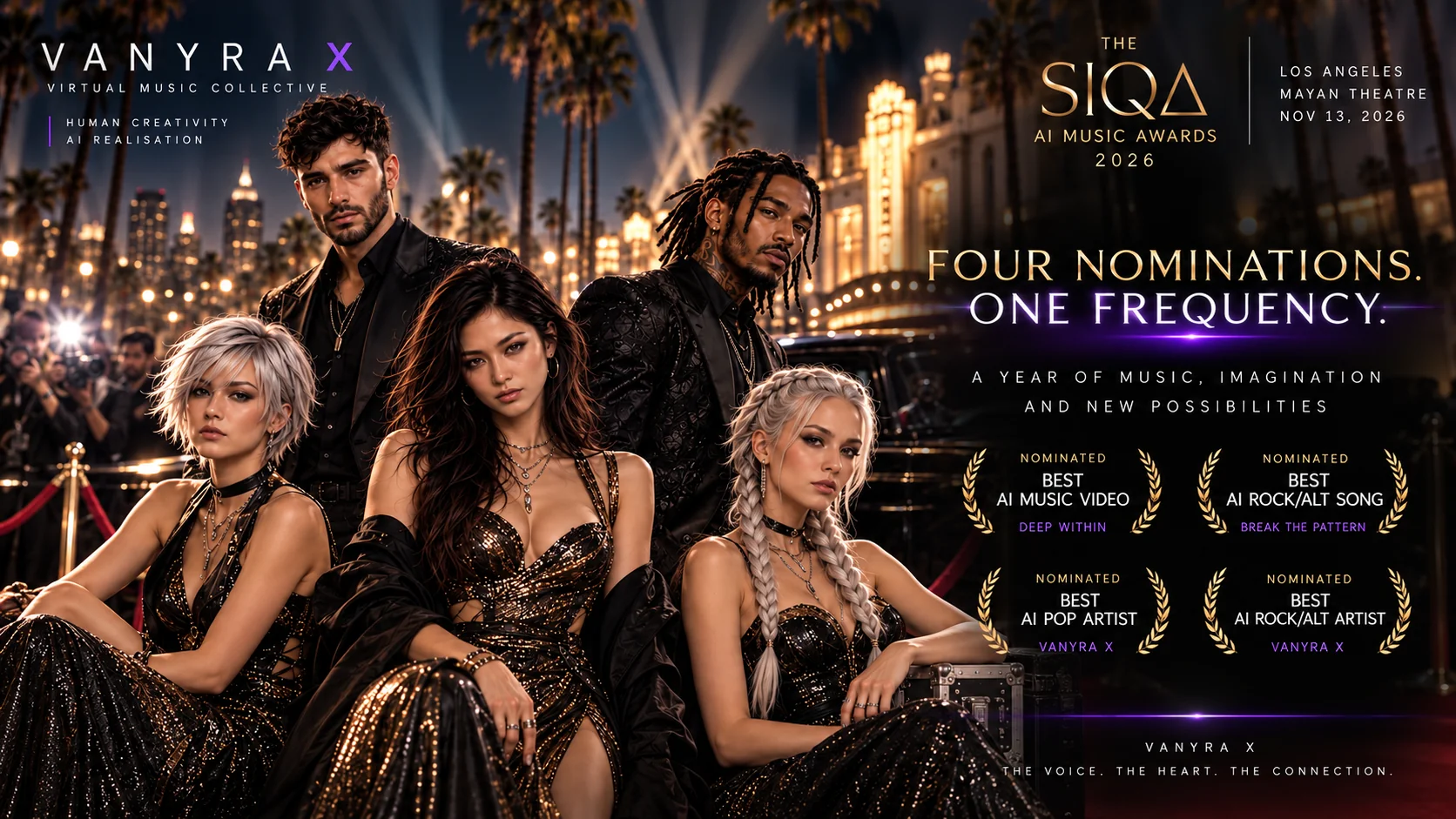
COCREON Media's virtual music collective VANYRA X offers one example of this approach. Its five fictional members form part of an ongoing creative concept combining human musical direction with AI-supported production and audiovisual storytelling.
The project's first-year journey — including four nominations at the 2026 AI Music Awards — is explored in our feature One Year of VANYRA X: From a Virtual Music Vision to Four AI Music Awards Nominations.
This example is not presented as a universal blueprint. Virtual music projects can follow many different production models, and their legal, artistic, and ethical questions remain complex.
But they illustrate a broader possibility: AI can become part of an expanding creative environment rather than simply a mechanism for generating isolated tracks.
The value of such an environment ultimately depends on the artistic choices that give it coherence.
The Future Belongs to Creative Decision-Makers
Generative AI is unlikely to make musical expertise irrelevant.
It is more likely to change where that expertise becomes most visible.
As the technical barriers to producing musical material decrease, artistic judgment, production experience, storytelling, and the ability to develop a distinctive identity may become increasingly important sources of creative differentiation.
This does not diminish the contribution of performers, composers, engineers, or other music professionals. Nor does it resolve legitimate concerns about training data, licensing, compensation, or the economic impact of automated content.
Those questions remain essential to any responsible future for AI music.
But there is a meaningful opportunity within the technological transition.
Musicians can use AI to explore ideas that would otherwise remain unrealized, while retaining responsibility for the creative choices that define their work.
The challenge is not to compete with machines at generating the greatest possible quantity of music.
It is to create music that has a reason to exist.
Because the next chapter of music will not be defined by prompts alone. It will be shaped by the people who know what they want to express — and why.
Editorial Note
This article presents an independent editorial perspective on human-AI collaboration in music production. It distinguishes artistic analysis from the policies and legal interpretations of the organizations cited. COCREON Media develops creative projects involving human direction and AI-assisted production, including VANYRA X. The article is not legal advice.
Sources and Further Reading
- IFPI (July 10, 2026) — Music community introduces new labelling program to distinguish generative AI in sound recordings.
https://www.ifpi.org/music-community-introduces-new-labelling-program-to-distinguish-generative-ai-in-sound-recordings/ - IFPI (July 30, 2026) — Global Principles for the Eligibility of Recordings Developed Using AI in Official Music Charts Worldwide.
https://www.ifpi.org/ifpi-rolls-out-global-principles-for-the-eligibility-of-recordings-developed-using-ai-in-official-music-charts-worldwide/ - Spotify (September 25, 2025) — Spotify Strengthens AI Protections for Artists, Songwriters, and Producers.
https://newsroom.spotify.com/2025-09-25/spotify-strengthens-ai-protections/ - U.S. Copyright Office (January 29, 2025) — Copyright and Artificial Intelligence, Part 2: Copyrightability.
https://www.copyright.gov/ai/ - Singla et al. (September 2026) — Human-AI Co-Creativity: Advances, Opportunities, and Challenges.
https://arxiv.org/abs/2609.07711 - UNESCO (November 25, 2025) — A New Expert Report Explores How AI Is Transforming Culture.
https://www.unesco.org/en/articles/new-expert-report-explores-how-ai-transforming-culture - IFPI (March 18, 2026) — Global Music Report 2026.
https://www.ifpi.org/global-music-report-2026-global-recorded-music-revenues-grow-6-4-as-record-companies-drive-innovation/