COCREON INSIGHTS | Digital Culture / Virtual Artists | 6 November 2026
When the Artist Is Virtual but the Experience Is Real
A listener discovers a song late at night. Its lyrics capture something they have struggled to express. They play it again, share it with a friend, and eventually begin following the artist.
Perhaps they watch music videos, read interviews, participate in conversations with other fans or wait for the next release.
Over time, the music becomes associated with memories, emotions and personal experiences.
Now imagine that the artist does not exist as a physical person.
The voice may be generated or digitally transformed. The face may belong to a fictional character. The public identity may be developed through animation, artificial intelligence, motion capture or a combination of technologies.
Does that make the listener's experience less real?
Not necessarily.
The relationship between audiences and performers has always involved imagination. Listeners rarely know the private individual behind a stage persona. They encounter a carefully selected public identity through recordings, performances, imagery and stories.
Virtual artists make that separation more visible.
Their existence raises questions about authenticity, authorship, emotional attachment and the increasingly complex relationship between technology and popular culture.
But they also invite a different way of thinking about artistic connection.
An artist's identity can be fictional without making the audience's emotional experience fictional.
Understanding that distinction may be essential to the next generation of music culture.
Virtual Artists Are Not a Single Technology
The term virtual artist is frequently used as though it describes one clearly defined category.
In reality, virtual music projects can differ dramatically.
Some feature animated characters whose voices and performances are supplied by human musicians. Others use motion capture to translate real performers into digital avatars.
Some combine human composition and production with AI-generated vocals or visuals. Others rely much more extensively on generative systems.
There are also fictional artists who exist primarily through illustrations, music videos, social media narratives or immersive digital experiences.
These distinctions matter.
A virtual identity does not automatically mean that the music is AI-generated. Likewise, AI-generated music does not necessarily require a virtual artist identity.
The relationship between the visible performer, the actual musical contributors and the technologies involved can take many forms.
For audiences, understanding those differences may become increasingly important.
For creators, explaining them accurately is part of building trust.
Why People Connect with Fictional Performers
Audiences have developed emotional attachments to fictional characters for generations.
Films, television series, literature, video games and animation all demonstrate that a character does not need to exist physically to become culturally meaningful.
Music adds another dimension.
A song can become part of someone's daily routine, personal identity or emotional history. The experience may be connected to a singer's voice, a particular melody, a lyrical message or the world surrounding an artist.
When those elements are presented through a fictional performer, the emotional response does not automatically disappear.
Psychological research offers a useful framework for understanding why.
Parasocial Relationships: Familiarity Without Personal Acquaintance
Researchers use the term parasocial relationship to describe a one-sided emotional bond with a media personality or character.
Such relationships are not exclusive to virtual artists. They have long been observed in audiences following actors, musicians, television personalities and other public figures.
Digital media can intensify the sense of familiarity through repeated exposure, direct-looking communication, regular updates and opportunities for community participation.
A preregistered study published in Media Psychology in September 2025 examined the development of parasocial relationships with human and virtual influencers.
Across four weeks, 185 young adult women in the Netherlands followed assigned influencers and repeatedly reported their relationship experiences.
The researchers found that parasocial relationship intensity increased over time in both conditions, with broadly similar progression through relationship stages.
The findings challenge the assumption that a virtual identity necessarily prevents audiences from developing emotional attachments.
However, the study investigated influencers rather than musical performers. Its results should not be interpreted as proof that every virtual musician will build the same kinds of relationships as a human artist.
What it does demonstrate is that the artificial nature of a media identity does not automatically eliminate the possibility of emotional engagement.
The Community Can Matter as Much as the Character
The relationship between a fan and a virtual artist is only part of the picture.
Fans also connect with one another.
They discuss releases, exchange interpretations, share artwork, recommend songs and celebrate milestones together.
A 2025 study in Computers in Human Behavior, based on survey responses from 303 Instagram users participating in virtual-influencer communities, found associations between follower interaction, social identity, parasocial interaction and attachment.
The research suggests that social relationships within a community can contribute to the attachment people experience toward a virtual personality.
For music projects, this raises an important possibility.
The long-term value of a virtual artist may depend not only on the appeal of the fictional character, but also on the community that develops around the music.
The shared experience becomes part of the artistic world.
What Virtual Idols Reveal About Modern Fandom
Virtual idols provide a particularly revealing example of how digital identities are becoming part of contemporary entertainment.
Across Asian pop culture, virtual performers have attracted attention through music releases, online appearances, elaborate visual identities and fan participation.
But the category includes very different production approaches.
Some virtual idols are powered by human performers using digital avatars. Others incorporate generative AI in more substantial ways.
Conflating these models can obscure the creative labor behind them.
Research into virtual idol culture increasingly examines the role of emotional expression, perceived authenticity and community engagement.
A June 2026 study published in Psychology & Marketing, titled Emotion and Engagement Across the Idol Spectrum: Comparing Virtual and Human Idols, analyzed a dataset of 16,583 YouTube videos.
The researchers investigated relationships between emotional expression, content format and audience engagement across human and virtual idol performances.
Among their findings, virtual idols showed different patterns of emotional expression and engagement, including a relationship between more extreme emotional expression and increased engagement.
This does not establish that virtual performers are inherently more engaging than human musicians.
Rather, it demonstrates that audience responses to virtual performers are complex and measurable — and that emotional presentation remains important even when the performer is digitally represented.
A separate 2026 study in Communication and Change, drawing on a survey of 259 K-pop fans, examined factors influencing the adoption of AI-mediated virtual idols.
Its findings highlighted the importance of relational and identity-related factors, suggesting that visual appeal alone may be insufficient to establish lasting trust.
These studies point toward a broader conclusion.
The technology may attract initial curiosity. But emotional meaning, recognizable identity and social connection are likely to determine whether audiences remain interested.
Authenticity Is More Than Physical Existence
Authenticity is one of the most contested concepts in discussions about virtual performers.
For some listeners, an artist must be a real person to be authentic.
Others accept fictional identities as legitimate artistic expressions, provided the people behind them communicate honestly about the nature of the project.
These perspectives reflect different expectations about what an artist represents.
A conventional singer-songwriter may be valued partly because audiences believe the performer is expressing personal experiences.
A fictional virtual artist may instead communicate through a character, narrative or artistic universe developed by human creators.
Neither format guarantees emotional honesty.
A real performer can present a carefully manufactured public image. A fictional character can communicate a meaningful story developed through genuine human creative intention.
The important distinction is between fiction and deception.
Fiction asks an audience to enter an imagined world.
Deception encourages an audience to believe something materially false about the people or processes behind that world.
For virtual music projects, transparency can help preserve that boundary.
A project may present a fictional singer as a recognizable character while also explaining that the character is digitally created and that real people contribute to the music, production or storytelling.
The audience can then appreciate the character without being misled about its physical existence.
This does not mean every creative illusion must be explained in every social media post.
Fictional storytelling depends on imagination.
But the essential nature of the project should not require audiences to discover a hidden truth before they can understand what they are supporting.
The Spotify AI Persona Debate: Identity, Disclosure and Discovery
In 2026, the question of virtual identity became more than a cultural discussion.
It also became a platform-policy issue.
In August, Spotify announced a new AI Persona badge intended to help listeners identify artist profiles presenting AI-generated, photorealistic human identities.
The company distinguishes between an artist's public identity and the technology used to produce the music.
An artist who uses AI tools in music production does not automatically qualify for an AI Persona badge.
Conversely, a photorealistic AI-generated artist identity may fall within the badge system regardless of how much human involvement exists in the underlying music.
Spotify offers self-disclosure through Spotify for Artists and also reviews profiles that may represent AI-generated identities.
By October 2026, Spotify reported that thousands of AI Personas had been labeled.
The policy has a significant consequence beyond transparency.
According to Spotify's published guidance, music from AI Personas is excluded from editorial and personalized recommendations by default, unless listeners intentionally engage with the artist — for example, by following the profile.
This creates a difficult tension.
On one hand, audiences have a legitimate interest in understanding whether the public identity they encounter represents a real person or a digitally created character.
On the other, a fictional artist's identity does not, by itself, establish whether the music is artistically valuable, ethically produced or meaningfully shaped by human creators.
A carefully developed virtual project and a minimally curated automated music operation can both involve synthetic identities, yet differ considerably in their creative processes.
Spotify's AI Persona policy addresses the identity presented to listeners. It should not be confused with a universal assessment of musical quality, copyright status or the extent of human authorship.
The precise implementation of recommendation restrictions may also evolve as platforms refine their policies.
For independent virtual artists, the issue is therefore both philosophical and practical.
How can platforms provide meaningful transparency without reducing every virtual music project to a single technological category?
And how can audiences discover new fictional artists when the mechanisms of music discovery increasingly distinguish between different types of identity?
These questions remain open.
Transparency Is Becoming Part of the Artist–Fan Relationship
Spotify's identity-focused approach is not the only transparency initiative emerging in the music industry.
In July 2026, a coalition including IFPI, RIAA, A2IM, WIN, IMPALA and other organizations announced a voluntary framework for distinguishing between AI-Generated and AI-Assisted sound recordings.
The proposed labels address the use of generative AI within recordings, rather than whether an artist's visual identity is fictional.
Under the announced framework, AI-Generated refers to recordings in which generative AI produces the entirety or primary portion of the recording's creative elements.
AI-Assisted is defined more narrowly, covering recordings substantially created by humans, with human performers providing lead vocals and primary instruments while AI contributes certain expressive elements.
These proposed categories do not capture every possible hybrid production workflow with equal precision.
They also do not automatically determine how an artist should describe the creative process in everyday communication.
A project involving AI-generated vocals, human-written music, newly recorded instruments and extensive human production may require a more detailed explanation than a single label can provide.
For virtual artists, transparency has at least two separate dimensions:
Who or what does the public-facing artist identity represent?
And:
How was the music itself created?
These questions should not be treated as interchangeable.
A fictional character can front a recording made entirely by human musicians. A real artist can release music incorporating extensive generative AI.
Accurate communication requires recognizing both possibilities.
Beyond the Character: Building a Sustainable Artistic Identity
Creating a memorable virtual artist involves much more than generating an attractive face.
A sustainable artistic identity needs coherence.
This does not mean every release must sound identical or that a fictional character can never evolve.
It means that listeners should be able to recognize a creative perspective across changing songs, visuals and narratives.
Several elements can contribute to that continuity.
Music Must Remain the Foundation
A compelling character may attract attention, but music provides the strongest reason for a listener to return to a music project.
Songwriting, arrangement, production, performance and emotional expression remain central.
Visual storytelling can deepen the experience, but it cannot guarantee that listeners will connect with the songs themselves.
Characters Need Consistency Without Becoming Static
A virtual artist's visual appearance, personality and narrative identity can evolve.
However, unexplained changes may weaken recognition or make the project feel disconnected.
Consistency does not require perfection. It requires a recognizable artistic logic.
Storytelling Should Support the Music
Fictional biographies, imagined performances and narrative worlds can make a project distinctive.
But storytelling becomes more effective when it reinforces the emotional themes of the music rather than functioning as a separate promotional layer.
Community Participation Should Be Genuine
Fans can recognize when interactions feel purely automated or transactional.
A virtual artist does not need to pretend to be an independent human being to maintain a meaningful community.
Real creators can listen to feedback, acknowledge support, share the development of a project and participate honestly in conversations.
Transparency Should Be Accessible
The people behind a virtual project do not necessarily need to become its public stars.
But audiences should have a reasonable way to understand the project's fictional nature and the role of AI in its creative process.
Trust is easier to sustain when important facts are not deliberately concealed.
VANYRA X: A Creative Project Between Fiction and Human Experience
One example of this evolving creative landscape is VANYRA X, the virtual music collective developed within COCREON Media.
The project features five fictional members and combines human musical direction, production work, AI-supported creative tools and audiovisual storytelling.
Its characters form part of an ongoing artistic concept rather than representing five physically existing performers.
The creative process behind the project involves human decisions about musical direction, arrangement, production, visual identity and narrative development.
For COCREON Media, the distinction between fictional performers and genuine creative work is fundamental.
The characters may be virtual, but the decisions, artistic ambitions and human contributions behind the project are real.
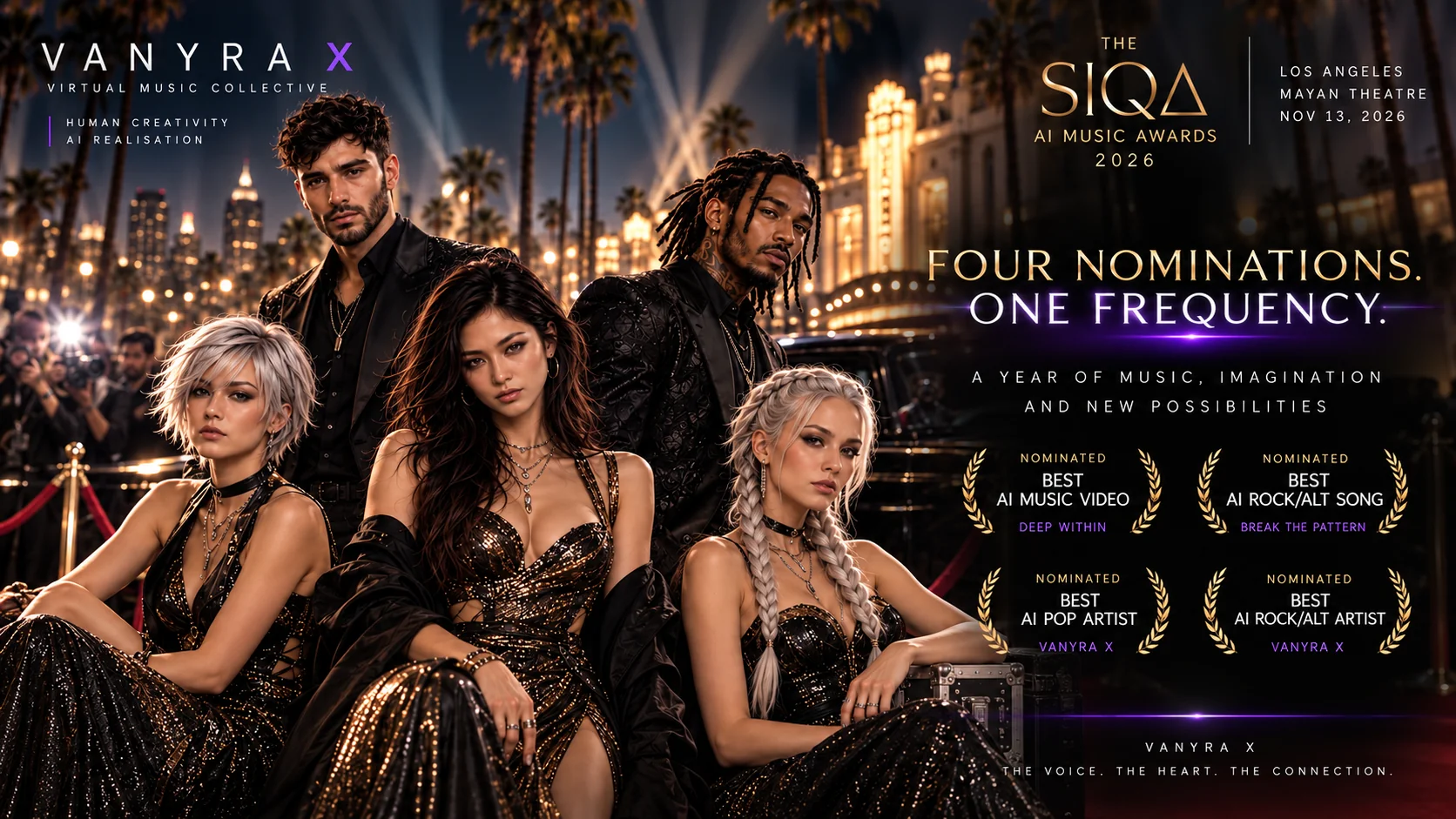
VANYRA X's first year — including four nominations at the 2026 AI Music Awards — is explored in our related feature, One Year of VANYRA X: From a Virtual Music Vision to Four AI Music Awards Nominations.
The project is presented here as an editorial case study, not as scientific evidence that a particular approach guarantees audience loyalty or commercial success.
Indeed, one of the challenges for any virtual music project is understanding how audiences respond over time.
Positive comments, streams and social media engagement can provide useful signals, but they cannot fully explain the depth or durability of emotional connections.
What a project can control is the care invested in its music, identity, communication and relationship with listeners.
The Ethical Boundaries of Virtual Intimacy
Virtual artistry offers exciting possibilities, but the ability to create emotionally persuasive fictional identities also carries responsibilities.
A digital character can appear consistently available, visually idealized and personally responsive.
If those characteristics are used to encourage unrealistic expectations of intimacy or personal reciprocity, audiences may become confused about the nature of the relationship.
This concern is especially relevant when interactive AI systems respond directly to fans.
A scripted social media post, a human-managed character account and an autonomous conversational agent are not the same thing.
Creators should consider whether audiences understand who or what is responding to them.
They should also avoid presenting automated intimacy as a substitute for genuine human relationships.
Other concerns include unauthorized voice or likeness imitation, misleading endorsements, inadequate disclosure of commercial relationships and the use of fictional identities to conceal exploitative practices.
These risks are not inevitable features of virtual artistry.
But they demonstrate why transparency, consent and responsible creative governance matter.
The opportunity to develop fictional music identities should not become an excuse to disregard the people who create, perform, listen to or financially support the music.
Can a Virtual Artist Become Part of Someone's Life?
Perhaps the most revealing question is not whether a virtual artist can imitate a human performer.
It is whether a virtual artist can create an experience that audiences value on its own terms.
A listener might associate a fictional singer with an important personal moment.
A group of fans might form friendships through a shared interest in a virtual band.
A song might inspire someone to begin making music, reconsider an experience or feel less alone.
Those outcomes do not require the fictional performer to exist physically.
They require the experience to matter to the people involved.
Research into virtual influencers and idols suggests that emotional attachment, perceived authenticity and community participation can all play roles in these relationships.
Yet there is still much to learn about how such connections develop specifically around AI-assisted music projects, how they change over time and how platform policies affect their visibility.
The field is evolving faster than many of the frameworks used to understand it.
That makes sweeping predictions premature.
Virtual artists are unlikely to replace the many forms of human performance and musical expression that audiences already value.
But they may become another established form of creative culture — one in which music, fiction, technology and human imagination intersect.
The Future of Authenticity May Be More Complex Than We Think
The rise of virtual artists challenges a familiar assumption: that authenticity depends entirely on the physical existence of the person audiences see.
In reality, authenticity has several dimensions.
There is authenticity of identity: whether an artist is presented honestly.
There is authenticity of process: whether creative contributions and technologies are described accurately.
And there is authenticity of expression: whether the work communicates something meaningful rather than merely imitating familiar patterns.
These dimensions do not always align neatly.
A fictional performer may be transparently presented, supported by substantial human creativity and capable of inspiring real emotional engagement.
A real performer may use extensive automation while maintaining a conventional public identity.
Neither situation can be understood through appearance alone.
The future of virtual artistry will depend not simply on better avatars, more convincing voices or increasingly sophisticated AI systems.
It will depend on the relationships between creators, characters, platforms and audiences.
Because an artist does not have to be physically real for the music to become part of someone's real life.
And perhaps that is the most important distinction of all.
Editorial Disclosure
COCREON Media develops creative projects involving virtual identities and AI-assisted production, including VANYRA X, which is discussed as an editorial example in this article.
This feature combines independent academic research, published platform policies and editorial analysis. Research concerning virtual influencers and idols is not automatically generalizable to all virtual music projects. Interpretations and future-oriented conclusions are identified as editorial perspectives rather than established scientific facts.
This article does not constitute legal or psychological advice.
Sources and Further Reading
- Spotify (August 11, 2026) — Spotify führt eine neue Kennzeichnung für KI-generierte Künstler*innen-Identitäten ein.
https://newsroom.spotify.com/2026-08-11/spotify-fuhrt-eine-neue-kennzeichnung-fur-ki-generierte-kunstlerinnen-identitaten-ein/ - Spotify for Artists — AI Persona badges on Spotify. Official support documentation, accessed November 2026.
https://support.spotify.com/us/artists/article/ai-personas/ - Spotify (October 20, 2026) — One Year In: Putting Human Artistry First on Spotify.
https://newsroom.spotify.com/2026-10-20/prioritizing-human-artistry/ - Breves, P. L. & van Berlo, Z. M. C. (2025) — Making and Breaking Parasocial Relationships with Human and Virtual Influencers: An Experience Sampling Study. Media Psychology.
https://doi.org/10.1080/15213269.2025.2558029 - Bang, J. & Han, S. (2025) — “I like community more than Influencers”: Unraveling the influence of followers on parasocial Interaction and attachment with virtual influencers. Computers in Human Behavior.
https://doi.org/10.1016/j.chb.2025.108796 - Kim et al. (2026) — Emotion and Engagement Across the Idol Spectrum: Comparing Virtual and Human Idols. Psychology & Marketing.
https://doi.org/10.1002/mar.70195 - Communication and Change (2026) — The emerging charisma of 0s and 1s: unraveling the intricacies of virtual idol adoption.
https://link.springer.com/article/10.1007/s44382-026-00041-4 - IFPI (July 10, 2026) — Music community introduces new labelling program to distinguish generative AI in sound recordings.
https://www.ifpi.org/music-community-introduces-new-labelling-program-to-distinguish-generative-ai-in-sound-recordings/ - Liu, J. (first published 2023) — Virtual presence, real connections: Exploring the role of parasocial relationships in virtual idol fan community participation. Global Media and China.
https://doi.org/10.1177/20594364231222976 - COCREON INSIGHTS — Beyond the Prompt: Why Human Creative Direction Is Becoming the Most Valuable Skill in AI Music.
https://cocreon.com/insights/beyond-the-prompt-human-creativity-ai-music/